
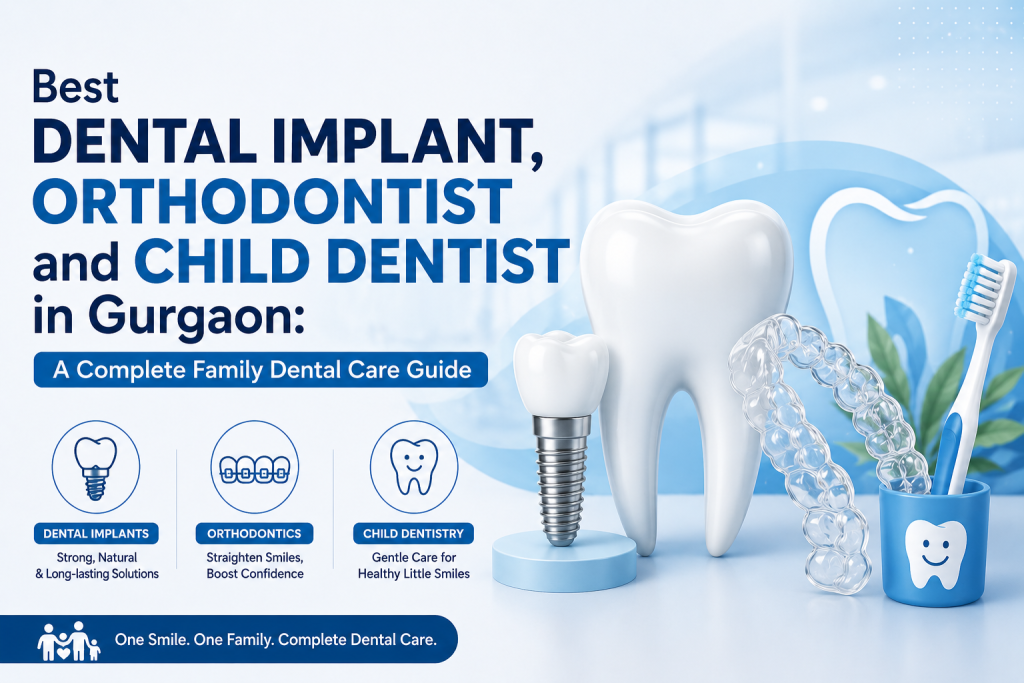
What to know before choosing a specialist for dental implants, orthodontic treatment, or your child’s dental care in Gurgaon
Dental care is rarely a single specialty. A family walking into a dental hospital over the course of a few years might need a dental implant for a grandparent, orthodontic braces for a teenager, and routine check-ups and fillings for a young child — three completely different disciplines within dentistry, each requiring its own training, equipment and clinical approach. Choosing a dental hospital that can genuinely deliver all three, rather than treating them as interchangeable services, makes a meaningful difference to the outcome in every case.
This guide walks through what dental implants, orthodontic treatment and paediatric dentistry actually involve, what questions to ask before committing to treatment, and how to evaluate whether a dental hospital has the depth of expertise each of these disciplines requires. Every clinical fact here reflects established dental practice, so you can use it to ask informed questions at your own consultation.
When to See Each Type of Dental Specialist
- A prosthodontist (implants, crowns, bridges, dentures) is the right specialist when a tooth is missing, badly broken down, or when existing crowns, bridges or dentures need replacement or repair.
- An endodontist (root canal specialist) is the right specialist when a tooth has deep decay reaching the nerve, or when there is persistent tooth pain, sensitivity to hot and cold, or swelling around a tooth’s root.
- An orthodontist is the right specialist when teeth are crowded, gapped, protruding, or when the upper and lower jaws do not meet correctly during biting and chewing.
- A periodontist is the right specialist when gums bleed during brushing, appear swollen or receded, or when there is looseness in otherwise healthy teeth, which can indicate bone loss around the tooth root.
- A paedodontist (child dentist) is the right specialist for any dental need in a child, from a first dental visit to fillings, extractions of primary teeth, and management of dental anxiety in young patients.
- An oral surgeon is the right specialist for impacted wisdom teeth, complex extractions, and surgical procedures involving the soft or hard tissue of the mouth.
Best Dental Implant in Gurgaon: Understanding Tooth Replacement Options
When a tooth is lost — whether due to decay, trauma, gum disease or a failed root canal — there are several ways to replace it, and dental implants sit within the broader discipline of prosthodontics, the branch of dentistry concerned with restoring and replacing teeth.
Fixed vs Removable Prosthodontics
Prosthodontic treatment is broadly divided into fixed and removable options. Fixed prosthodontics covers permanently attached restorations — also called indirect restorations — including crowns, bridges, inlays, onlays and veneers. Removable prosthodontics covers dentures, which can be complete or partial depending on how many natural teeth remain.
Dental Crowns: Materials and Purpose
A dental crown is a tooth-shaped cap placed over a tooth to restore its shape, size and strength, and to improve its appearance. Once cemented into place, a crown fully encases the visible portion of the tooth at and above the gum line. Permanent crowns can be made from several different materials — stainless steel, all-metal (such as gold or another alloy), porcelain-fused-to-metal, all-resin, or all-ceramic — and the right choice depends on the tooth’s location, the bite forces it needs to withstand, and aesthetic priorities. Molars that absorb heavy chewing forces, for instance, are often better suited to metal or porcelain-fused-to-metal crowns, while front teeth prioritise the more tooth-like appearance of all-ceramic crowns.
Dentures: What Patients Should Realistically Expect
For patients who need a removable option, fabricating a denture typically takes around six to seven clinical sittings. With complete dentures, the fit of the upper or lower denture depends significantly on how much bone ridge remains in the jaw — a factor that varies from patient to patient and affects how secure the denture feels. New denture wearers commonly report a temporary “full-mouth” sensation, as though the denture is pushing the lips forward, along with occasional gagging or accidentally biting the cheek or tongue in the early days. These sensations typically diminish as the mouth adjusts. Increased saliva production is also common initially and settles over time. Taste can feel muted at first because the brain is processing signals from the denture rather than fully focusing on the taste buds, and sensing food temperature accurately can take some practice. Denture wearers are generally advised to start with soft foods such as eggs, fish, chopped meat, cooked vegetables and puddings, cut food into small pieces, and chew evenly on both sides of the mouth to balance pressure on the denture. Daily cleaning — brushing the denture the same way natural teeth are brushed, rinsing after meals, and removing the denture every night so the gum tissue underneath can rest — is essential to denture longevity and oral health.
Why Implants Are Often Preferred Over Traditional Bridges or Dentures
A dental implant is a titanium post surgically placed into the jawbone to act as an artificial tooth root, onto which a crown is later attached. Because the implant integrates directly with the jawbone through a biological process known as osseointegration, it provides a stable, independent foundation that does not rely on adjacent teeth for support — unlike a traditional fixed bridge, which requires the neighbouring teeth to be reshaped and crowned to anchor the replacement tooth. This is one of the central clinical advantages of implants: healthy adjacent teeth are left untouched rather than being altered to support a restoration.
What to Ask Before Choosing Where to Get a Dental Implant
- Does the treating dentist have specific training or a postgraduate qualification in prosthodontics or implantology, rather than placing implants as an occasional add-on to general practice?
- What pre-surgical imaging is used to assess bone quality and quantity before planning implant placement?
- How is the final crown material selected, and is the full range of crown materials — metal, porcelain-fused-to-metal, all-ceramic — available depending on the tooth location?
- What is the expected number of clinical visits from the initial consultation through to the final crown placement?
- What aftercare and maintenance instructions are provided, and how are follow-up reviews scheduled?
Best Orthodontist in Gurgaon: Straightening Teeth the Right Way
Orthodontics is the branch of dentistry that corrects teeth and jaws that are positioned improperly. This is not simply a cosmetic concern. Crooked teeth and teeth that do not fit together correctly are genuinely harder to keep clean, which raises the risk of tooth decay and periodontal (gum) disease over time. Misaligned bites also place extra stress on the muscles used for chewing, which can contribute to headaches, temporomandibular joint (TMJ) syndrome, and pain in the neck, shoulders and back. The benefits of orthodontic treatment, therefore, span three areas at once: a healthier mouth that is easier to clean and maintain, a more pleasing appearance, and teeth that are more likely to last a lifetime because they are not subjected to abnormal bite forces.
Types of Braces Available Today
Orthodontic treatment today is not limited to the traditional metal-braces image most people have in mind. A properly equipped orthodontic department typically offers a full range of options so that treatment can be matched to the patient’s clinical needs, budget and aesthetic preference.
- Full metal braces — the traditional and most cost-effective fixed appliance option.
- Semi-aesthetic braces — a combination approach that reduces visibility compared with full metal braces.
- Full aesthetic (ceramic) braces — tooth-coloured brackets designed to be far less noticeable than metal.
- Lingual braces — fitted to the back (tongue side) of the teeth, making them invisible from the front.
- Clear aligners — a series of removable, transparent trays that gradually move teeth as an alternative to fixed braces.
How Orthodontic Appliances Actually Work
Both fixed and removable orthodontic appliances work by applying gentle, sustained pressure on the teeth and jaws over time. This pressure gradually moves teeth into corrected positions, and in growing patients, can also influence and guide jaw growth. The severity of the misalignment determines which orthodontic approach is likely to be most effective — a mild spacing issue may be well suited to clear aligners, while a more complex bite correction involving jaw relationship may require fixed appliances over a longer treatment period. This is why an orthodontic treatment plan should always follow a proper clinical assessment rather than a patient self-selecting a treatment type based on appearance preference alone.
Clear Aligners as an Alternative to Traditional Braces
Clear aligner treatment uses a series of custom-made, removable transparent trays as an alternative to fixed metal braces. Because they are removable, aligners allow for easier brushing, flossing and eating compared with fixed braces, though they require patient discipline, since the trays must be worn for the prescribed number of hours each day to be effective.
Questions to Ask an Orthodontist Before Starting Treatment
- Which of the available brace types — metal, semi-aesthetic, aesthetic, lingual or aligners — is genuinely most suitable for my specific bite and alignment issue, and why?
- What is the estimated total treatment duration, and how frequently will follow-up adjustments be needed?
- Will any teeth need to be extracted to create space before orthodontic treatment begins?
- What retention plan (retainers) is recommended after the active treatment phase ends, to prevent teeth from shifting back?
Best Child Dentist in Gurgaon: Why Children Need Specialised Dental Care
Paedodontics — also called paediatric dentistry — is the branch of dentistry that deals specifically with children. Treating a child’s teeth is clinically and behaviourally different from treating an adult’s, which is exactly why this is recognised as its own specialty rather than simply “dentistry performed on a smaller patient.” A qualified child dentist is trained to manage a young patient’s anxiety, communicate treatment in age-appropriate ways, and make clinical decisions that account for the fact that a child’s teeth, jaws and bite are still developing.
Core Services in Paediatric Dentistry
- Fillings — treating cavities in both primary (milk) and permanent teeth to stop decay from progressing.
- Extractions — removing teeth that are severely decayed, infected, or need to be removed to guide proper eruption of permanent teeth.
- Pulpectomy — a procedure similar in principle to a root canal, performed on primary teeth to treat infection of the tooth’s pulp while preserving the tooth until it is naturally ready to fall out.
- Space maintainers — small appliances used to hold open the gap left by a prematurely lost primary tooth, preventing neighbouring teeth from drifting into the space and causing crowding or misalignment of the permanent teeth that follow.
- Cleft lip and cleft palate surgical care — specialised treatment for children born with these congenital conditions, requiring coordinated care as part of a broader treatment plan.
Why Primary (Milk) Teeth Matter More Than Many Parents Realise
It is a common misconception that cavities in milk teeth do not need urgent attention because “the tooth is going to fall out anyway.” In reality, primary teeth serve as space holders for the permanent teeth developing beneath them, and losing a primary tooth too early — whether through decay or extraction — can allow neighbouring teeth to shift and crowd the space meant for the permanent tooth, which is precisely why space maintainers exist as a dedicated treatment option. Primary teeth also play a direct role in a child’s ability to chew properly, speak clearly, and maintain confidence in their smile during formative years.
Making Dental Visits Manageable for Children
A well-run paediatric dental setup focuses on patience and a calm clinical environment as much as on the procedures themselves, since a child’s early experiences with dental visits often shape their attitude toward oral health care for the rest of their life. Establishing a dental home early — meaning a consistent place a child returns to for regular check-ups rather than only visiting a dentist during an emergency — allows problems to be caught and treated while they are still minor, and helps the child build familiarity and trust with the clinical setting over repeated visits.
Questions to Ask a Child Dentist
- What behaviour management techniques are used to help anxious or first-time young patients feel comfortable?
- At what age should my child have their first dental visit, and how often should routine check-ups follow after that?
- If a primary tooth needs to be extracted early, will a space maintainer be recommended to protect the alignment of permanent teeth?
- How are dental x-rays handled for children, given the need to minimise radiation exposure in younger patients?
Root Canal Treatment: A Related Discipline Worth Understanding
Because tooth loss requiring an implant, and tooth decay requiring orthodontic or restorative planning, are often connected to untreated deep decay, it is worth briefly understanding root canal treatment (RCT) as well, since it frequently determines whether a natural tooth can be saved in the first place. A root canal becomes necessary when a tooth is badly decayed or infected, and during the procedure, the damaged pulp and nerve tissue inside the tooth is removed to prevent the infection from spreading further. Root canal treatment is generally considered one of the final options in managing severe tooth decay, since after the pulp is removed, the tooth is considered non-vital and becomes more fragile than a healthy tooth.
Root canal treatment is reported to be around 95% successful as a procedure, with the outcome influenced by factors including the patient’s general health, the condition of the tooth’s nerves and root canals, the bone support around the tooth, and the presence of any fracture lines in the tooth structure. Treatment generally takes three to four sittings to complete for an infected tooth, though in cases of intentional (elective) root canal treatment, the entire procedure can sometimes be completed in a single sitting lasting two to three hours. A crown is usually recommended after root canal treatment because a root-canal-treated tooth no longer has its own blood supply and becomes more brittle over time — this is especially important for molars and premolars, which absorb the greatest chewing forces and are therefore more prone to fracture without the added strength of a crown. Root-canal-treated teeth have no nerve but can still decay, so ongoing home care, a proper diet and regular dental check-ups remain just as important as for any other tooth.
Gum Health and Oral Surgery: Two Disciplines That Support Implant and Orthodontic Success
Periodontics: Why Healthy Gums Come Before Implants or Braces
Periodontics is the branch of dentistry focused on the structures that support the teeth — the gums, the periodontal ligament, and the underlying bone. Healthy gum tissue and adequate bone support are not optional extras when planning a dental implant; they are a precondition. An implant placed into compromised or infected gum tissue, or into bone that has already been weakened by untreated periodontal disease, is far more likely to fail than one placed after the gums and bone have been properly stabilised. The same logic applies to orthodontic treatment — moving teeth through bone and gum tissue that is inflamed or diseased is both less predictable and less comfortable for the patient than moving teeth through healthy supporting structures. This is precisely why a dental hospital with a dedicated periodontics department is better positioned to prepare a patient properly before implant or orthodontic treatment begins, rather than proceeding directly to the more visible procedure and addressing gum health only if problems arise afterward.
Oral Surgery: Extractions, Impacted Teeth and Beyond
Oral surgery covers procedures that go beyond routine dental treatment, including the surgical removal of impacted wisdom teeth, complex extractions, and minor surgical procedures involving the soft and hard tissue of the mouth. Impacted wisdom teeth — third molars that do not have enough room to erupt normally — are one of the most common reasons patients require oral surgery, since an impacted tooth left untreated can lead to infection, damage to neighbouring teeth, or crowding that can undo the results of prior orthodontic treatment. This is another example of how the different departments of a dental hospital connect: a wisdom tooth removed at the right time by an oral surgeon can directly protect the outcome of orthodontic work completed years earlier.
Understanding What Influences the Cost of Dental Treatment
Cost is one of the first questions most patients ask, but a meaningful answer can only come after a clinical examination, because each of these treatments varies significantly in scope from patient to patient. The cost of a dental implant is influenced by the number of implants needed, the condition of the underlying jawbone, whether any additional procedure such as a bone graft is required before the implant can be placed, and the crown material selected for the final restoration. The cost of orthodontic treatment depends on the type of appliance chosen — metal braces, aesthetic braces, lingual braces or aligners each involve different material and laboratory costs — as well as the expected duration of treatment and the complexity of the bite correction required. The cost of paediatric dental care depends on the specific procedure needed, whether it is a simple filling, a pulpectomy, or placement of a space maintainer, and how many teeth are involved. Rather than comparing a single quoted figure across different providers, ask for a written treatment plan and cost estimate only after a full clinical examination and, where relevant, dental x-rays, so that the estimate reflects your actual treatment needs rather than a generic starting price.
Why Continuity of Care Across Specialties Matters
The reason it makes sense to think about implants, orthodontics and paediatric dentistry together, rather than as unrelated services, is that dental health across a family is rarely static. A child who needed a space maintainer at age seven may need orthodontic evaluation by age eleven or twelve. An adult who avoided a root canal for years may eventually need an implant once the tooth cannot be saved. A hospital that maintains dedicated departments for endodontics (root canal treatment), paedodontics (children’s dentistry), periodontics (gum health), prosthodontics (implants, crowns and dentures) and orthodontics (bite and alignment correction) is structured to follow a patient through these different life stages, rather than treating each visit as an isolated transaction. This continuity also matters clinically — a dentist who has treated a patient’s root canal is better positioned to advise on whether that same tooth will eventually need a crown or an implant, because they already have direct knowledge of that tooth’s history.
When evaluating a dental hospital, it is worth asking whether these disciplines exist as distinct, staffed departments with dentists specifically trained in each area, rather than a single general dentist attempting to cover every discipline. Dentistry, much like medicine, has moved firmly toward sub-specialisation because each of these areas — implant surgery, orthodontic biomechanics, and the behavioural and clinical nuances of treating children — requires focused training that a general practice degree alone does not fully cover.
A Practical Checklist for Choosing a Dental Hospital
- Confirm that dedicated departments exist for endodontics, paedodontics, periodontics, prosthodontics and orthodontics, rather than one general dentist covering everything.
- For implants, ask about pre-surgical imaging, the range of crown materials offered, and the number of visits required from planning to final placement.
- For orthodontics, ask which brace types are available (metal, aesthetic, lingual, aligners) and request a bite assessment before committing to a specific appliance.
- For your child, ask about the dentist’s approach to first visits, behaviour management, and whether space maintainers are used when primary teeth are lost early.
- For any tooth with deep decay, ask whether root canal treatment can save the tooth before extraction and implant placement are considered.
- Ask whether the hospital holds recognised accreditation (such as NABH) and is empanelled under relevant government or insurance health schemes.
Frequently Asked Questions
-
What is the difference between a dental implant and a traditional bridge?
A dental implant is a titanium post placed directly into the jawbone to act as an artificial tooth root, supporting its own crown independently. A traditional bridge, by contrast, relies on the teeth adjacent to the gap being reshaped and crowned to anchor the replacement tooth, meaning healthy neighbouring teeth are altered in the process.
-
What materials are dental crowns made from?
Permanent crowns can be made from stainless steel, all-metal alloys such as gold, porcelain-fused-to-metal, all-resin, or all-ceramic materials. The right choice depends on which tooth is being restored and the bite forces it needs to withstand.
-
How many dental visits does it usually take to complete a denture?
Fabricating a denture typically takes around six to seven clinical sittings, and how well the denture fits depends significantly on the amount of bone ridge remaining in the jaw.
-
At what age should orthodontic treatment start?
The right time for orthodontic treatment depends on the specific alignment or bite issue involved and should be determined through a clinical assessment rather than a fixed age rule, since some corrections are more effective while the jaw is still growing and others are better addressed once all permanent teeth have erupted.
-
Are clear aligners as effective as traditional braces?
Clear aligners are a genuine alternative to fixed braces for many cases, offering the advantage of being removable for eating, brushing and flossing. The severity of the misalignment determines which approach is likely to be most effective, which is why a clinical assessment should guide the choice between aligners and fixed appliances.
-
What is a pulpectomy, and why does my child need one instead of an extraction?
A pulpectomy is a procedure similar to a root canal but performed on a primary (milk) tooth, removing infected pulp tissue while preserving the tooth structure. It is often preferred over extraction because it keeps the primary tooth in place as a natural space holder until it is ready to fall out on its own.
-
Why does losing a primary tooth early matter if it was going to fall out anyway?
Primary teeth hold space for the permanent teeth developing underneath them. If a primary tooth is lost too early, neighbouring teeth can drift into the empty space, leading to crowding or misalignment of the permanent tooth when it eventually erupts. This is why space maintainers are used to hold the gap open when a primary tooth is lost prematurely.
-
How successful is root canal treatment, and how many sittings does it take?
Root canal treatment is reported to be around 95% successful. It generally takes three to four sittings for an infected tooth, though an intentional (elective) root canal can sometimes be completed in a single sitting of two to three hours.
-
Why is a crown usually needed after a root canal?
A tooth that has undergone root canal treatment no longer has its own blood supply and becomes more brittle over time, making it more prone to fracture — especially back teeth that absorb heavy chewing forces. A crown strengthens and protects the tooth after the procedure.
-
Can a root-canal-treated tooth still decay?
Yes. A root canal removes the nerve of the tooth, but the surrounding tooth structure can still develop new decay, so ongoing brushing, flossing, a proper diet and regular dental check-ups remain essential even after treatment.
Final Thoughts
Dental implants, orthodontic treatment and children’s dentistry each address a distinctly different clinical need, and choosing a provider with dedicated expertise and infrastructure in the exact discipline you need — rather than a single generalist attempting to cover all of them — has a direct bearing on treatment outcome. Use the questions and checklist in this guide at your next consultation, ask for specifics rather than general reassurance, and choose a dental hospital that treats these as connected but distinct specialties, each staffed and equipped accordingly.
