
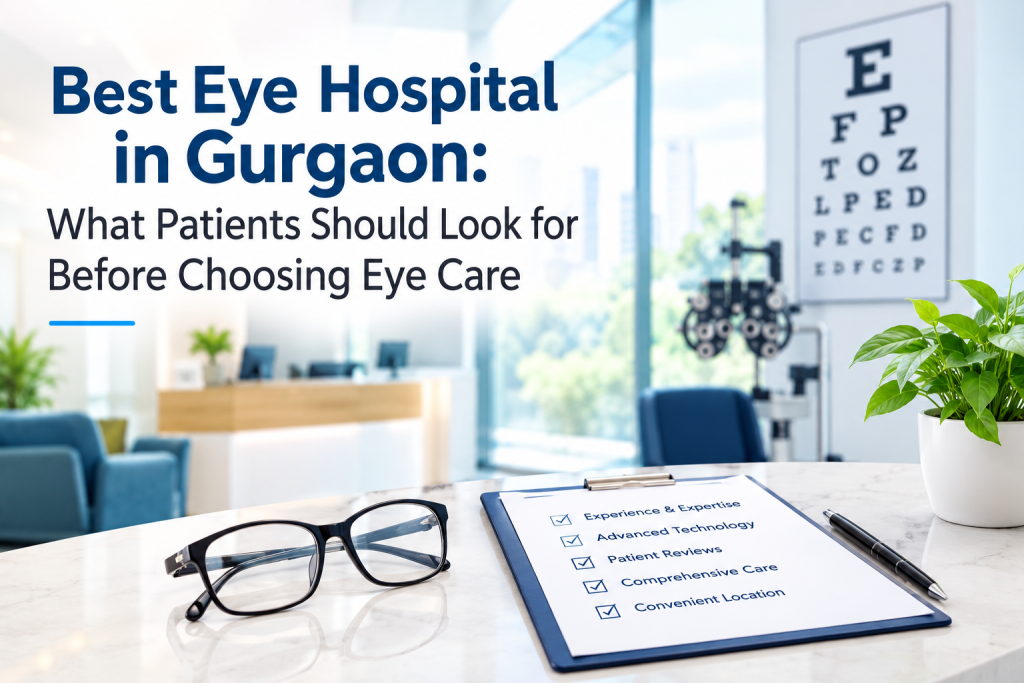
Choosing the best eye hospital in Gurgaon is not simply about finding a clinic close to home or selecting the first name that appears in a search result. Eye care can range from a routine vision examination to specialised management of cataract, corneal disease, glaucoma, retinal disorders, refractive errors and other conditions. The right choice depends on the patient’s symptoms, age, medical history, diagnosis and the type of specialist care required.
A good eye-care facility should therefore offer more than a prescription for glasses. Patients may need proper diagnostic evaluation, specialist consultation, treatment planning, surgery when indicated and appropriate follow-up. A comprehensive ophthalmic evaluation can identify vision problems as well as eye diseases that may not produce noticeable symptoms in their early stages.
What Makes an Eye Hospital a Comprehensive Eye-Care Centre?
A comprehensive eye hospital should ideally be able to assess the patient’s condition and direct them to the appropriate area of ophthalmology when necessary.
Important factors include:
- Qualified ophthalmologists with relevant subspecialty experience
• Comprehensive eye examinations
• Appropriate diagnostic testing
• Cataract and refractive surgery services
• Cornea care
• Glaucoma evaluation and management
• Retina and vitreoretinal services
• Paediatric ophthalmology where required
• Contact lens and low-vision services
• Proper surgical facilities
• Post-treatment monitoring and follow-up
Ahooja Eye & Dental Institute (AEDI) in Gurgaon provides multiple areas of eye care, including cataract, cornea, Contoura LASIK, glaucoma, contact lens services, paediatric ophthalmology, ocular prosthesis and retina services.
Why a Comprehensive Eye Examination Matters
Many people visit an eye clinic only after noticing blurred vision. However, clear vision does not necessarily mean that every part of the eye is healthy.
Some eye diseases can develop without obvious symptoms, particularly in their early stages. A comprehensive examination can evaluate visual acuity and other aspects of ocular health, with additional testing depending on the patient’s age, symptoms and risk factors.
A comprehensive evaluation may include:
Visual acuity assessment
This determines how clearly a person can see at different distances and helps identify refractive errors such as myopia, hyperopia and astigmatism.
Refraction
Refraction helps determine the optical prescription required for glasses or contact lenses.
Eye pressure measurement
Tonometry can be used as part of an assessment for conditions involving intraocular pressure, including glaucoma. Eye pressure alone does not establish a glaucoma diagnosis.
Peripheral vision assessment
Visual field testing evaluates how well a person can see objects outside their direct line of sight.
Retina and optic nerve evaluation
Depending on the patient’s circumstances, the ophthalmologist may examine the retina and optic nerve, sometimes after dilation.
Additional diagnostic tests
If the clinical examination indicates a need for further investigation, specialised imaging or diagnostic testing may be recommended.
Not every patient needs every test. Diagnostic investigations should be selected according to the clinical situation rather than performed simply because they are available.
Choosing the Right Specialist Is as Important as Choosing the Hospital
An eye hospital can have excellent facilities, but the most appropriate specialist depends on the patient’s condition.
For example, a person with a cloudy lens and progressive difficulty reading may need a cataract evaluation. Someone experiencing flashes, floaters or distortion may require retinal assessment. A patient with keratoconus may need corneal evaluation.
AEDI’s doctor directory lists specialists working across cataract, cornea, refractive surgery, retina, vitreoretinal surgery, medical retina and oculoplasty, among other areas.
Patients should always review the specialist’s qualifications and area of practice rather than choosing a doctor only because of a generic title such as ‘eye specialist.’
Cataract Care: Look Beyond the Word ‘Surgery’
Cataract is one of the most common reasons adults seek ophthalmic treatment.
A cataract develops when the natural lens of the eye becomes cloudy, potentially causing blurred or hazy vision, glare and difficulty performing everyday activities. Whether surgery is appropriate depends on the patient’s symptoms, visual requirements and clinical findings.
When considering an eye hospital for cataract treatment, patients should ask:
- Who will perform the evaluation?
2. What type of cataract surgery is appropriate?
3. Which intraocular lens options are suitable?
4. Are there other eye conditions that could affect the outcome?
5. What follow-up will be required?
AEDI has a dedicated cataract service and states that its cataract facilities include two operation theatres designed according to NABH standards.
Patients can learn more here: https://aedi.in/best-eye-hospital-gurgaon/cataract-surgery-gurgaon/
Cornea Care Requires Specialist Evaluation
The cornea is the transparent front surface of the eye and plays an important role in focusing light.
Corneal conditions can range from common surface problems to more complex disorders such as keratoconus, corneal scarring, infections, dystrophies and conditions requiring transplantation.
AEDI’s cornea service lists management of conditions including keratoconus, corneal edema, corneal dystrophies, corneal ulcers, dry eye, corneal scarring, infections and anterior-segment trauma or inflammation. Its service page also describes corneal transplant procedures including penetrating keratoplasty, DALK and DSEK.
For more information: https://aedi.in/best-eye-hospital-gurgaon/cornea-treatment/
LASIK and Refractive Surgery: A Consultation Comes Before the Procedure
Patients considering LASIK often begin their search with phrases such as ‘best LASIK surgery in Gurgaon’ or ‘best eye hospital in Gurgaon for LASIK.’
The important question is whether a particular refractive procedure is appropriate for the individual’s eyes.
A refractive surgery consultation generally considers current refractive error, corneal shape and thickness, ocular surface health, stability of the prescription, age, previous eye conditions or surgery, patient expectations and other clinical findings.
AEDI provides Contoura Vision LASIK services in Gurgaon and describes the procedure as a topography-guided approach to refractive correction.
Service information: https://aedi.in/best-eye-hospital-gurgaon/contoura-lasik-gurgaon/
When ICL May Be Considered
Some patients seeking freedom from glasses or contact lenses may not be ideal candidates for corneal laser procedures. In selected cases, an implantable lens procedure such as ICL may be considered.
ICL is not an alternative that every LASIK patient should choose. Eligibility depends on an ophthalmic assessment and factors such as prescription, eye anatomy and overall ocular health.
AEDI lists ICL surgery among its eye-care services. The important principle is that treatment should follow the examination, not the other way around.
Glaucoma: Why Routine Vision Can Be Misleading
Glaucoma deserves particular attention because it can progress without obvious symptoms.
A patient may feel that their vision is normal while changes are developing in the optic nerve. Appropriate examination and risk assessment are therefore important, particularly for people with relevant risk factors.
Patients should consider a glaucoma evaluation if advised by an ophthalmologist, particularly when there is a family history or other recognised risk factors.
AEDI provides a dedicated glaucoma service as part of its ophthalmology department.
Retina Care Is Especially Important for People With Diabetes
Diabetes can affect the retina and cause diabetic retinopathy. Importantly, diabetic retinopathy may not cause symptoms in its early stages.
Patients may require specialised retinal assessment depending on their clinical condition.
AEDI’s retina service states that its vitreoretinal department manages conditions including diabetic retinopathy, retinal detachment, age-related macular degeneration, trauma and inflammation. It also lists diagnostic modalities such as OCT, OCTA, FFA and B-scan.
Retina service: https://aedi.in/best-eye-hospital-gurgaon/retina-uvea-services/
Why Diagnostic Capability Matters
Modern eye care is not based only on looking through a slit lamp and checking a glasses prescription.
Depending on the clinical question, an ophthalmologist may recommend imaging or functional tests to understand a patient’s eye more thoroughly.
Technology should support clinical decision-making rather than replace it.
A useful way to evaluate an eye hospital is: Clinical examination + appropriate diagnostics + specialist interpretation + personalised treatment planning + follow-up.
What Patients Should Ask Before Choosing an Eye Hospital in Gurgaon
- Does the hospital treat my specific condition?
2. Is the appropriate subspecialist available?
3. Can diagnosis and treatment be coordinated?
4. What tests will I actually need?
5. What are my treatment options?
6. What should I expect after treatment?
7. What should I bring to my consultation?
Previous prescriptions, medical records, reports and details of existing medications can help the ophthalmologist understand your history.
When Should You See an Eye Specialist?
An eye consultation may be appropriate when you notice persistent blurred vision, difficulty seeing at night, new flashes or floaters, distorted vision, sudden change in vision, eye pain or redness, increasing sensitivity to light, difficulty reading despite updated glasses, a known diagnosis requiring monitoring, a family history of certain eye diseases, or diabetes and other health conditions associated with eye complications.
Sudden vision loss, sudden severe eye pain, a new curtain-like shadow in vision or other acute changes can require urgent medical assessment rather than a routine appointment.
How Often Should Adults Have Eye Examinations?
There is no single examination schedule that applies to everyone.
Adults without symptoms or risk factors generally have different recommended examination intervals according to age, while people with conditions such as diabetes or increased glaucoma risk may need more frequent assessment.
The frequency should therefore be determined according to age, risk factors, symptoms, previous diagnoses and the ophthalmologist’s findings.
This is especially important for people who assume that an eye examination is unnecessary because their glasses prescription has not changed. A vision check and a comprehensive medical eye evaluation are not necessarily the same thing.
Why Local Access Matters When Choosing the Best Eye Hospital in Gurgaon
Eye care is often an ongoing process. A patient may need initial examination, diagnostic testing, specialist consultation, treatment, surgery, postoperative review and long-term monitoring.
For this reason, convenience and accessibility matter, particularly for older adults and patients requiring repeated visits.
AEDI is located at:
Ahooja Eye & Dental Institute
560/1, Dayanand Colony
New Railway Road
Gurgaon, Haryana, India
The official website lists the board numbers as 0124-2321234 and 8130784234, with contact@aedi.in as the listed email address.
Website: https://aedi.in/
AEDI’s Approach to Comprehensive Eye Care
Ahooja Eye & Dental Institute states that it was established in 1969 by Dr. T. N. Ahooja and provides ophthalmology and dental services in Gurgaon. Its eye-care department covers cataract, cornea, LASIK, glaucoma, contact lenses, paediatric ophthalmology, ocular prosthesis and retina services.
The hospital also lists a multidisciplinary eye-care team that includes cataract, cornea and refractive surgeons as well as retina and vitreoretinal specialists.
For a patient, the practical benefit of such a broad service structure is that an eye problem can be evaluated and, where necessary, directed toward the appropriate subspecialty.
What ‘Best’ Should Mean for Your Eye Care
There is no universally correct answer to which hospital is ‘best’ for every patient.
The right eye hospital is the one that can appropriately address your particular clinical need with qualified specialists, suitable diagnostic evaluation, medically appropriate treatment options and proper follow-up.
Rather than choosing an eye hospital solely because of advertising language, patients should look at the quality and relevance of the care available for their specific situation.
Frequently Asked Questions
1. What should I look for when choosing the best eye hospital in Gurgaon?
Look for a hospital with qualified ophthalmologists, appropriate diagnostic facilities, relevant subspecialists, surgical capability where required and a clear follow-up process. The most suitable hospital depends on your specific eye condition and treatment requirements.
2. Is a routine eye test enough to detect eye disease?
Not always. A routine vision test primarily assesses how clearly you see, while a comprehensive eye examination can evaluate broader aspects of ocular health. Some eye diseases may have few or no noticeable symptoms in their early stages.
3. Which specialist should I see for cataract?
A cataract or refractive surgeon can evaluate your cataract and discuss whether surgery is appropriate. The choice of intraocular lens should be based on examination findings, visual requirements and individual circumstances.
4. Can LASIK be performed on everyone who wears glasses?
No. LASIK suitability varies from person to person. A detailed preoperative assessment is required to evaluate factors such as refractive error, corneal characteristics and overall eye health.
5. When should I see a cornea specialist in Gurgaon?
A cornea specialist may be appropriate for conditions such as keratoconus, corneal scarring, corneal infection, corneal dystrophy, persistent corneal problems or other disorders affecting the front surface of the eye.
6. Should people with diabetes have regular eye examinations?
Yes. Diabetes can cause diabetic retinopathy, which may initially have no obvious symptoms. Comprehensive eye examinations are important, with frequency determined according to the individual’s circumstances.
7. Does normal eye pressure mean I do not have glaucoma?
No. Eye pressure is only one part of glaucoma assessment. A complete evaluation may involve optic nerve assessment, visual field testing and other clinical findings.
8. What happens during a comprehensive dilated eye examination?
Depending on the patient, the examination may include visual acuity, visual field assessment, pupil responses, eye-pressure measurement and dilation to examine internal structures of the eye. Additional testing may be recommended when clinically appropriate.
9. Does AEDI provide retina and vitreoretinal services in Gurgaon?
Yes. AEDI lists retina and uvea services covering conditions including diabetic retinopathy, retinal detachment and age-related macular degeneration, along with diagnostic investigations such as OCT, OCTA, FFA and B-scan.
10. How can I book an appointment at Ahooja Eye & Dental Institute?
You can contact AEDI at 0124-2321234 or 8130784234, or use the appointment facility available through the official website. The hospital is located at 560/1, Dayanand Colony, New Railway Road, Gurgaon, Haryana.
Book an Eye Consultation in Gurgaon
If you are experiencing a change in vision, have an existing eye condition or simply need a comprehensive ophthalmic assessment, choosing the right specialist is an important first step.
Ahooja Eye & Dental Institute provides multiple areas of ophthalmic care in Gurgaon, including cataract, cornea, refractive surgery, glaucoma, retina, contact lens services and paediatric ophthalmology.
Ahooja Eye & Dental Institute
560/1, Dayanand Colony
New Railway Road, Gurgaon, Haryana, India
Phone: 0124-2321234, 8130784234
Email: contact@aedi.in
Website: https://aedi.in/
Conclusion
Searching for the best eye hospital in Gurgaon should begin with the quality and relevance of medical care, not simply with a hospital’s position in a search result.
A comprehensive eye-care centre should be able to evaluate vision, identify potential eye disease, provide access to relevant specialists and recommend treatment based on individual clinical findings. For patients with cataract, corneal disease, refractive errors, glaucoma, retinal conditions or other eye concerns, the right diagnosis is the foundation for choosing the right treatment.
Ahooja Eye & Dental Institute offers a broad range of ophthalmic services in Gurgaon, supported by specialist teams across several areas of eye care. Patients can contact the institute directly to discuss their condition and determine which consultation is appropriate for them.
