
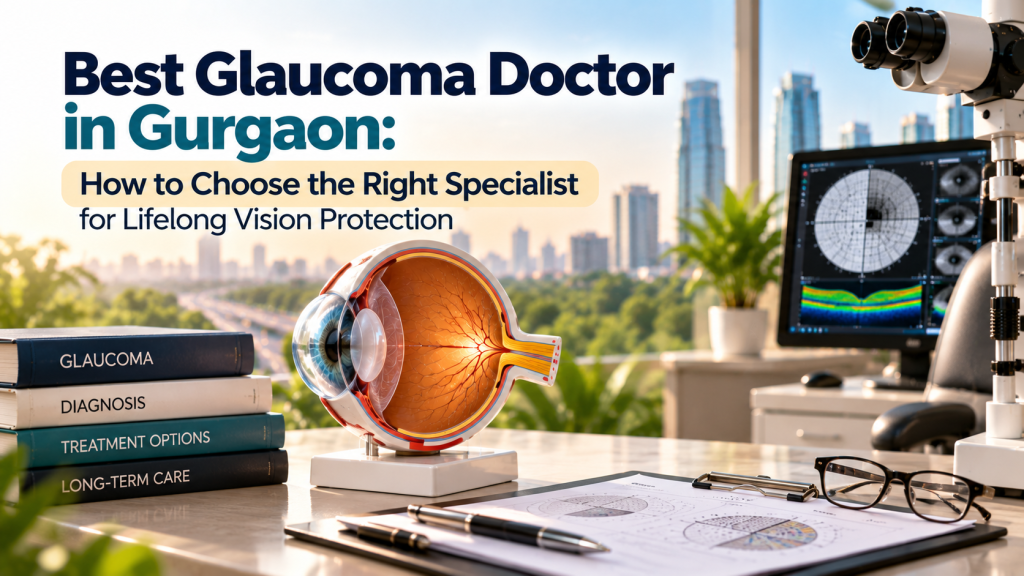
A patient-focused guide to glaucoma risk, diagnosis, treatment and long-term monitoring in Gurugram
Glaucoma is often called a silent threat to vision because the most common forms can progress for years without obvious early symptoms. Many people continue reading, driving and working normally while damage is developing in the optic nerve. By the time noticeable side-vision loss appears, some of that damage may already be permanent. This is why the search for the best glaucoma doctor in Gurgaon should not begin only after vision becomes poor. It should begin with the right questions: Who needs screening? Which tests are actually important? How is glaucoma distinguished from simply having high eye pressure? What does long-term monitoring involve? And how do you choose a specialist who can manage the condition over time?
For patients in Gurgaon and nearby areas, Ahooja Eye & Dental Institute (AEDI) provides a dedicated glaucoma service within its comprehensive ophthalmology department. The hospital’s official doctor profile lists Dr. (Prof.) Manav Deep Singh as Senior Glaucoma Consultant, with expertise in comprehensive glaucoma diagnosis and management, medical and surgical glaucoma care, advanced and complex glaucoma, glaucoma drainage devices and long-term monitoring. This article explains how patients can approach glaucoma care intelligently, what to expect during evaluation and why continuity of follow-up matters just as much as the first consultation.
Quick Answer: What Should You Look for in the Best Glaucoma Doctor in Gurgaon?
A suitable glaucoma specialist should be able to do more than check eye pressure. Glaucoma diagnosis and follow-up may require optic nerve examination, gonioscopy to assess the drainage angle, visual field testing, OCT assessment of the retinal nerve fibre layer, corneal thickness measurement and repeat comparison over time. Treatment may involve prescription eye drops, laser procedures or surgery depending on the type and severity of disease.
For patients comparing options in Gurgaon, look for a clinician with focused glaucoma expertise, access to appropriate diagnostics, experience with both routine and complex disease, and a system for regular follow-up. The goal is not simply to lower a number on the tonometer. The goal is to preserve useful vision by identifying risk, detecting progression and adjusting treatment when necessary.
Why Glaucoma Needs Specialist Attention Even When Vision Feels Normal
Glaucoma refers to a group of eye diseases that damage the optic nerve. The National Eye Institute notes that early glaucoma often has no symptoms and that the condition may gradually affect peripheral vision before a person realises that anything is wrong. Because lost vision from glaucoma generally cannot be restored, early detection and treatment are important for reducing the risk of further damage.
A common misunderstanding is that glaucoma always causes high eye pressure. Eye pressure is an important risk factor, but it is not the entire diagnosis. Some people have higher-than-average eye pressure without glaucomatous optic nerve damage, while others develop glaucoma even when measured pressure is within a range that might otherwise appear normal. This is why a proper glaucoma evaluation considers the optic nerve, visual field, drainage angle, corneal thickness and other clinical findings rather than relying on a single pressure reading.
Another reason specialist care matters is that glaucoma is not one uniform disease. Open-angle glaucoma, angle-closure disease and secondary glaucomas can have different mechanisms and management needs. A treatment plan should therefore follow the diagnosis, not the other way around.
Who Should Consider a Glaucoma Evaluation?
Anyone can develop glaucoma, but some people have a higher risk and should discuss appropriate examination intervals with an ophthalmologist. Risk becomes more relevant with increasing age, a family history of glaucoma, previously detected high eye pressure, thin central cornea, certain eye injuries, long-term steroid exposure and some systemic or ocular conditions. A family history is particularly important because glaucoma can run in families.
People who already have a glaucoma diagnosis need more than occasional screening. They generally require planned follow-up so that the doctor can compare pressure, optic nerve appearance, OCT measurements and visual field results over time. The frequency of review depends on the type of glaucoma, severity, treatment response and perceived risk of progression.
You should also seek urgent ophthalmic assessment for sudden severe eye pain, redness, blurred vision, halos, headache, nausea or vomiting. These symptoms can occur in acute angle-closure glaucoma and should not be treated as a routine appointment issue.
Why an Eye Pressure Check Alone Is Not Enough
A quick pressure measurement is useful, but it cannot by itself confirm or exclude glaucoma. Eye pressure varies among individuals and can also vary at different times. In addition, corneal thickness can influence how pressure readings are interpreted. This is one reason why a glaucoma work-up may include pachymetry to measure corneal thickness.
The drainage angle of the eye is also important. Gonioscopy allows the ophthalmologist to assess whether the angle is open, narrow or closed and helps guide diagnosis and management. Optic nerve evaluation looks for structural changes associated with glaucoma. Visual field testing assesses functional loss, particularly peripheral vision. OCT can measure the retinal nerve fibre layer and other optic nerve-related structures, helping the clinician detect and monitor structural change.
At AEDI, the dedicated glaucoma service page lists Goldmann applanation tonometry, gonioscopy, visual field analysis, OCT, anterior-segment OCT and corneal pachymetry among the diagnostic tools used for glaucoma assessment. Full details are available at https://aedi.in/best-eye-hospital-gurgaon/glaucoma-treatment/.
The Key Glaucoma Tests and What Each One Tells the Doctor
Understanding the purpose of each test makes glaucoma care less confusing. Not every test is required at every visit, and the ophthalmologist chooses investigations according to the clinical situation.
- Tonometry measures intraocular pressure. Pressure is important because lowering it is the main proven strategy used to reduce the risk of glaucoma progression, but the target pressure is individualised.
- Gonioscopy examines the angle where fluid leaves the front of the eye. It helps classify the glaucoma mechanism and is particularly important when angle-closure disease is suspected.
- Visual field testing maps central and peripheral vision. Glaucoma often affects the field of vision in characteristic patterns, and repeat testing can help identify functional progression.
- Optical coherence tomography, or OCT, creates cross-sectional measurements of structures such as the retinal nerve fibre layer. Serial OCT scans can be valuable because the trend across multiple visits may matter more than one isolated result.
- Pachymetry measures central corneal thickness. This information helps the ophthalmologist interpret eye pressure readings in the wider clinical context.
- Dilated optic nerve examination remains fundamental. Imaging supports clinical examination, but the diagnosis is not made by a machine alone. A specialist combines test findings, medical history and the appearance of the optic nerve before deciding whether a patient has glaucoma, is a glaucoma suspect or simply needs observation.
What “Long-Term Monitoring” Really Means in Glaucoma Care
Glaucoma is usually managed as a long-term condition. A good first consultation is important, but consistent follow-up is what allows the ophthalmologist to determine whether treatment is working.
Monitoring may include repeat pressure measurement, optic nerve examination, OCT and visual field testing. The doctor looks for change rather than simply asking whether the patient feels better. This distinction matters because glaucoma treatment often does not make vision feel sharper. Eye drops are commonly prescribed to reduce eye pressure and protect the optic nerve from further damage. A patient may feel exactly the same before and after starting treatment, yet the treatment may still be doing an important job.
Bring previous glaucoma reports whenever possible. Old OCT scans, visual field printouts, pressure records and surgery details can help the doctor understand whether the disease is stable or progressing. If you are changing hospitals or seeking a second opinion, a chronological set of previous reports is particularly useful.
How Glaucoma Treatment Is Chosen
There is no single glaucoma treatment that is appropriate for every patient. The plan depends on glaucoma type, disease severity, eye pressure, optic nerve status, visual field damage, age, other eye problems, medication tolerance and previous treatment.
Prescription eye drops are commonly used to lower intraocular pressure. Some reduce fluid production inside the eye, while others improve fluid drainage. Correct technique and regular use are important because inconsistent treatment can reduce effectiveness.
Laser treatment may be appropriate in selected types of glaucoma. For example, laser procedures may be used to improve drainage in open-angle disease or to create an opening in the iris in certain angle-closure situations. The exact procedure depends on the diagnosis.
Surgery may be considered when pressure is not adequately controlled with medicines or laser, when disease is advanced, or when the specialist believes a surgical approach is appropriate. AEDI’s glaucoma service lists medical treatment, laser procedures and surgical options including trabeculectomy and glaucoma drainage implants. More information is available at https://aedi.in/best-eye-hospital-gurgaon/glaucoma-treatment/.
The important principle is individualisation. A treatment that is suitable for one person may not be suitable for another, even if both are described as having glaucoma.
How to Choose the Best Glaucoma Doctor in Gurgaon for Your Needs
The word “best” is subjective, and no responsible medical article can declare that one doctor is universally best for every patient. A more useful approach is to evaluate whether the specialist’s expertise and clinical setup match your needs.
First, look for focused glaucoma experience. Glaucoma can be simple to monitor in some patients and highly complex in others. A clinician who routinely manages glaucoma is better positioned to interpret progression, adjust target pressure and decide when medical, laser or surgical treatment should change.
Second, check whether the facility offers the tests required for diagnosis and follow-up. Repeatedly travelling to different centres for pressure checks, fields, OCT and specialist review can make long-term care harder.
Third, consider continuity. Glaucoma is not a one-visit problem. The ability to compare results across months or years is important. A good clinical system should make it practical to return for planned review.
Fourth, ask clear questions. What type of glaucoma do I have? What is my target pressure? Has my optic nerve changed? How often should I repeat my visual field or OCT? What side effects should I watch for? What happens if the current treatment does not control the disease? The quality of the consultation includes whether you understand the plan when you leave.
Glaucoma Expertise at Ahooja Eye & Dental Institute, Gurgaon
Ahooja Eye & Dental Institute provides glaucoma care as part of its ophthalmology services in Gurgaon. The official doctors page lists Dr. (Prof.) Manav Deep Singh as Senior Glaucoma Consultant. His profile states that he has over 37 years of experience in ophthalmology and completed a glaucoma fellowship at L. V. Prasad Eye Institute, Hyderabad. It also lists expertise in comprehensive glaucoma diagnosis and management, medical and surgical glaucoma treatment, complex and advanced glaucoma care, glaucoma drainage devices and long-term monitoring.
His official profile can be reviewed at https://aedi.in/dr-manav-deep-singh/.
AEDI’s broader eye-care department includes multiple ophthalmic subspecialties. This can be relevant when glaucoma coexists with cataract, corneal disease, retinal disease or other eye conditions. The complete eye-care overview is available at https://aedi.in/best-eye-hospital-gurgaon/.
Patients can also review the full eye-care team at https://aedi.in/about-aedi/gurgaon-doctors/.
When Glaucoma and Cataract Occur Together
Glaucoma and cataract both become more common with age, so some patients have both conditions. Cataract affects the natural lens and can cause cloudy or blurred vision, glare and difficulty in low light. Glaucoma affects the optic nerve. Treating cataract does not automatically treat glaucoma, and glaucoma-related vision loss is not restored simply by removing a cataract.
When both conditions are present, the ophthalmologist considers which problem is responsible for the patient’s symptoms, how well pressure is controlled and whether cataract surgery could influence the overall management plan. Some patients may undergo cataract surgery alone, while others may need additional glaucoma treatment. The decision depends on the individual eye.
Patients who are also exploring cataract care can review AEDI’s cataract service at https://aedi.in/best-eye-hospital-gurgaon/cataract-surgery-gurgaon/.
Practical Tips for Patients Already Using Glaucoma Eye Drops
Glaucoma medicines only work when they are used consistently. If a drop is prescribed daily, missing doses repeatedly can undermine pressure control. Use the medicine exactly as directed and tell your ophthalmologist if you experience redness, irritation, breathing difficulty, dizziness or any other suspected side effect rather than stopping the medicine on your own.
Bring all current eye drops to appointments or keep an updated list with the exact names and dosing schedule. If more than one drop is prescribed, ask how much time to leave between them. Good technique can reduce wastage and improve delivery of the medicine to the eye.
Do not assume treatment is unnecessary because you do not feel symptoms. Glaucoma therapy is usually preventive: it aims to reduce the chance of further optic nerve damage. Keep follow-up appointments even when vision feels unchanged.
What to Bring to a Glaucoma Consultation
A well-prepared visit can help the specialist make better use of your consultation time. Bring previous eye prescriptions, old OCT and visual field reports, prior pressure records, details of any laser or eye surgery, and a complete list of medicines including steroid tablets, inhalers, creams or eye drops. Mention any family history of glaucoma and any previous eye injury.
If you have diabetes, blood pressure problems or other long-term medical conditions, tell the doctor. If you have been treated elsewhere, note the highest pressure you were told about, the names of previous drops and why any medicine was changed or stopped.
If your pupils are dilated during the visit, near vision and light sensitivity may be temporarily affected. Ask the clinic in advance whether you may need someone to accompany you, particularly if you are uncomfortable driving after dilation.
Local Glaucoma Care in Gurgaon: Why Accessibility Matters
Glaucoma management often involves repeated visits rather than a single procedure. This makes location, appointment access and follow-up organisation practical considerations, especially for older adults or patients who need serial testing.
Ahooja Eye & Dental Institute is located at 560/1, Dayanand Colony, New Railway Road, Gurgaon, Haryana, India. The official contact page lists the Eye Care appointment number as 8130784234 and the board number as 0124-2321234. Hospital timings are listed as Monday to Saturday, 8:30 AM to 5:30 PM, with Sunday closed. Patients should confirm the specialist’s current visiting schedule while booking because consultant timings can change.
Contact and location details: https://aedi.in/contact-us/
Online appointment page: https://aedi.in/contact-us/book-appointment/
Do Not Wait for Advanced Symptoms
One of the most important facts about glaucoma is also the easiest to ignore: many patients do not notice early damage. Waiting for obvious tunnel vision is not a safe screening strategy. If you have been told that your eye pressure is high, if a previous doctor has called you a glaucoma suspect, if glaucoma runs in your family, or if you are already receiving treatment, follow the review schedule advised by your ophthalmologist.
Urgent symptoms are different. Sudden severe eye pain, marked redness, blurred vision, halos around lights, headache, nausea or vomiting can require emergency evaluation. These symptoms should not be delayed while waiting for a routine clinic slot.
For everyone else, the most useful approach is steady, planned care: appropriate testing, a clear diagnosis, consistent treatment when prescribed and regular comparison of results over time.
Frequently Asked Questions
1. What is the difference between high eye pressure and glaucoma?
High eye pressure is a risk factor, but it is not the same as glaucoma. Glaucoma is diagnosed by assessing the optic nerve and other findings, which may include visual field testing, OCT, gonioscopy and corneal thickness. Some people have high pressure without optic nerve damage, while some develop glaucoma with pressure readings that are not unusually high.
2. Can glaucoma be cured?
Glaucoma-related optic nerve damage generally cannot be reversed. Treatment is aimed at lowering eye pressure and reducing the risk of further damage. Medicines, laser treatment or surgery may be used depending on the type and severity of glaucoma.
3. How do I know if I need to see a glaucoma specialist?
You should consider specialist evaluation if you have been diagnosed with glaucoma, have repeatedly high eye pressure, suspicious optic nerve findings, abnormal visual field or OCT results, a strong family history, narrow drainage angles, or progression despite treatment. A general ophthalmologist may also refer you when the case needs subspecialty assessment.
4. What tests are commonly used to diagnose glaucoma?
A glaucoma evaluation may include intraocular pressure measurement, dilated optic nerve examination, gonioscopy, visual field testing, OCT and pachymetry. The exact combination depends on the patient and the suspected type of glaucoma.
5. Does normal eye pressure rule out glaucoma?
No. Some people develop glaucoma even when measured eye pressure is within a range considered normal for many individuals. Diagnosis depends on the whole clinical picture, not a single pressure reading.
6. How often should glaucoma patients have follow-up visits?
There is no one schedule for everyone. Follow-up frequency depends on the type of glaucoma, degree of damage, pressure control, treatment changes and risk of progression. Your ophthalmologist should give you an individual review schedule.
7. Can glaucoma eye drops restore lost vision?
No. Glaucoma drops are used to lower eye pressure and help reduce the risk of further optic nerve damage. They do not usually restore vision that has already been permanently lost from glaucoma.
8. When is glaucoma surgery considered?
Surgery may be considered when pressure remains inadequately controlled, when disease is advanced or progressing, when medicines or laser are not sufficient or suitable, or when the specialist determines that surgery offers the most appropriate pressure-lowering approach.
9. Who is the glaucoma specialist at AEDI in Gurgaon?
AEDI’s official website lists Dr. (Prof.) Manav Deep Singh as Senior Glaucoma Consultant. His profile lists expertise in comprehensive glaucoma diagnosis and management, medical and surgical glaucoma care, complex glaucoma, drainage devices and long-term monitoring. Patients should confirm current consultation days and timings when booking.
10. How can I book a glaucoma consultation at AEDI?
You can contact Ahooja Eye & Dental Institute at the Eye Care appointment number 8130784234 or board number 0124-2321234. The hospital is located at 560/1, Dayanand Colony, New Railway Road, Gurgaon, Haryana. You can also use the online appointment page at https://aedi.in/contact-us/book-appointment/.
Book a Glaucoma Consultation at AEDI, Gurgaon
Ahooja Eye & Dental Institute (AEDI) is located at 560/1, Dayanand Colony, New Railway Road, Gurgaon, Haryana, India.
Eye Care appointment: 8130784234 | Board: 0124-2321234 | Email: contact@aedi.in
Official website: https://aedi.in/
Glaucoma service: https://aedi.in/best-eye-hospital-gurgaon/glaucoma-treatment/
Book appointment: https://aedi.in/contact-us/book-appointment/
Conclusion
Searching for the best glaucoma doctor in Gurgaon is ultimately about finding the right clinical fit for a condition that may need lifelong observation. The most useful specialist is one who can confirm the diagnosis carefully, interpret pressure in context, assess the optic nerve, use visual field and imaging appropriately, explain the treatment target and monitor for change over time.
Ahooja Eye & Dental Institute offers a dedicated glaucoma service in Gurgaon and lists Dr. (Prof.) Manav Deep Singh as Senior Glaucoma Consultant. For patients who need evaluation of raised eye pressure, a second opinion, long-term glaucoma monitoring or discussion of medical, laser or surgical treatment, a specialist consultation can help establish a clear plan.
Do not wait for obvious loss of side vision before seeking care. With glaucoma, timely diagnosis and consistent follow-up are central to protecting the vision you still have.
