
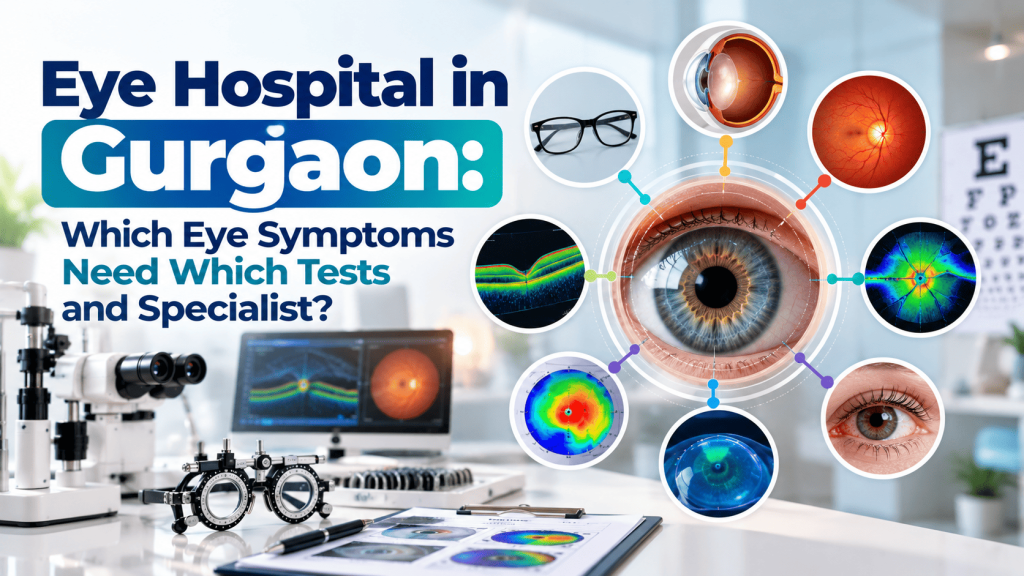
A practical guide to timely eye examinations, referral decisions and treatment conversations for patients in Gurugram.
Why the type of eye problem matters
Blurred vision, discomfort, glare and headaches can feel similar, but they do not always point to the same condition. A change in spectacle power may cause gradual blur. Cataract can produce glare and reduced contrast. Corneal disease may distort the image. Glaucoma can damage the optic nerve without an obvious early warning. Retinal disorders can affect central vision or produce flashes and floaters. Choosing an eye hospital in Gurgaon should therefore begin with the right clinical question: what is causing the symptom, and what examination will help establish the diagnosis?
Ahooja Eye & Dental Institute (AEDI) in Gurgaon lists cataract, cornea, glaucoma, retina and uvea, refractive surgery, ICL, contact lens, and paediatric ophthalmology among its eye-care services. This guide explains when different eye concerns call for routine assessment, specialist review or urgent medical attention. It is educational information, not a way to diagnose yourself.
First, identify warning signs that should not wait
Seek urgent ophthalmic or emergency assessment for sudden loss of vision, a dark curtain moving across vision, new flashes with many floaters, a painful red eye accompanied by reduced vision, significant eye injury, or a chemical splash. Sudden double vision with weakness, facial droop, severe headache or other neurological symptoms needs emergency evaluation. Delay may reduce the chance of preserving vision in some conditions.
For a chemical splash, immediately irrigate the eye continuously with clean running water or saline while arranging emergency care. Do not delay irrigation to search for eye drops or a clinic. If you wear contact lenses and develop a painful, red, light-sensitive eye, remove the lenses and seek prompt assessment. Never wear the lenses again until an eye-care professional advises it.
Symptoms that are gradual but persistent, including blurred distance vision, glare, fluctuating vision, eye strain or recurring redness, still deserve a proper appointment. A phone call cannot reliably distinguish common irritation from an eye condition that requires examination.
What happens during a comprehensive eye examination?
A clinician begins by asking how long the problem has existed, whether it affects one eye or both, what makes it worse, and whether there is pain, light sensitivity, diabetes, medication use, previous surgery or relevant family history. Visual acuity and refraction help establish what can be corrected with glasses. An examination of the eyelids, tear film, cornea, lens and other structures helps identify possible causes.
Eye pressure measurement, optic nerve examination and pupil dilation may be recommended when glaucoma or retinal disease is a concern. Dilating drops temporarily blur near vision and can increase sensitivity to light, so patients should ask whether they need someone to accompany them home. Not every patient needs every test. The doctor selects investigations based on clinical findings, risk and the decision that must be made.
If vision is cloudy or headlights cause glare: investigate cataract
Cataract develops when the eye’s natural lens becomes cloudy. Patients may describe faded colours, poor night-time visibility, halos or changing spectacle power. These symptoms can overlap with dry eye and corneal problems, so cataract should be confirmed rather than assumed. An eye examination also checks for additional issues that could influence visual expectations after surgery.
A cataract surgeon in Gurgaon may assess the impact of symptoms on reading, driving and everyday independence before discussing the timing of surgery. In some cases, an updated prescription is enough for the time being. When cataract meaningfully restricts activities, surgery replaces the cloudy lens with an intraocular lens. Lens selection depends on eye measurements, corneal astigmatism, eye health, visual priorities and the limitations of each design.
AEDI provides cataract evaluation and has a dedicated page explaining its cataract service:
AEDI cataract surgery and treatment — https://aedi.in/eye-hospital-gurgaon/cataract-surgery-gurgaon/
Bladeless cataract surgery: which questions should patients ask?
Femtosecond laser-assisted cataract surgery can automate selected steps of cataract surgery. It is commonly described as bladeless or robotic cataract surgery, although a surgeon remains responsible for planning, performing and monitoring the operation. The word “bladeless” does not mean incision-free, risk-free or suitable for everyone. Conventional phacoemulsification remains a well-established treatment option.
Patients exploring bladeless cataract surgery in Gurgaon should ask which steps involve a laser, why the surgeon recommends the technique for their particular eye, what options exist for the intraocular lens and how other eye conditions may influence results. A clear discussion of risks, costs, expected recovery and realistic glasses dependence is more useful than choosing on technology terminology alone.
AEDI robotic bladeless cataract surgery — https://aedi.in/eye-hospital-gurgaon/robotic-bladeless-cataract-surgery/
If vision is distorted, the eye is painful or light is uncomfortable: assess the cornea
The cornea is the clear, curved front surface of the eye. It provides much of the eye’s focusing power and protects internal structures. Corneal disorders can cause blur, irregular vision, watering, sensitivity to light and pain. Examples include infections, injuries, keratoconus, scars and certain conditions affecting the corneal surface. Persistent symptoms need an examination because treatment differs markedly by cause.
A cornea specialist in Gurgaon may use slit-lamp examination, corneal topography or tomography, and other tests when indicated. For suspected keratoconus, mapping the corneal shape and thickness helps inform monitoring and possible management. Someone with a corneal infection requires a different response from someone with an irregular corneal shape. Avoid self-prescribing steroid eye drops, which may worsen particular infections.
Corneal assessment can also be relevant before LASIK or other refractive surgery. A patient who sees clearly with spectacles may still have a corneal characteristic that makes elective laser correction unsuitable. That is why an eligibility assessment must go beyond checking spectacle power.
If there are no symptoms but glaucoma risk exists: test the optic nerve
Glaucoma refers to a group of diseases that can damage the optic nerve. Many people with open-angle glaucoma do not notice problems early, and vision already lost from glaucoma generally cannot be restored. Risk assessment may be particularly important for people with a family history, older adults, those with certain eye conditions and patients with elevated eye pressure or suspicious optic nerve findings.
A glaucoma doctor in Gurgaon may combine eye pressure measurement with optic nerve assessment, optical coherence tomography (OCT), visual field testing, examination of the drainage angle and corneal thickness evaluation. No single eye-pressure reading can definitively establish or exclude glaucoma. Some people develop glaucoma despite pressure readings within the usual range.
Treatment may include drops, laser or surgery depending on glaucoma type, stage, target eye pressure and the patient’s circumstances. Monitoring is essential even when vision feels stable. A sudden painful red eye with halos, headache, nausea or reduced vision may indicate an acute pressure-related emergency and requires immediate assessment.
AEDI glaucoma treatment information — https://aedi.in/eye-hospital-gurgaon/glaucoma-treatment/
If straight lines bend, floaters suddenly appear or diabetes affects vision: consider a retina examination
The retina is the light-sensitive tissue lining the back of the eye. A central retinal problem can distort faces or straight lines, while some peripheral retinal problems may initially go unnoticed. New flashes, a sudden shower of floaters or a curtain-like shadow are warning signs that require urgent dilated retinal examination because a retinal tear or detachment is possible.
People with diabetes should undergo retinal screening at intervals advised by their treating clinicians, including when vision seems normal. Diabetic retinopathy may have no noticeable early symptoms. Age-related macular degeneration, retinal vein disease, inflammatory conditions and other retinal disorders also require condition-specific evaluation.
A retina specialist in Gurgaon may recommend dilated fundus examination, OCT, retinal imaging, fluorescein angiography or ultrasound when medically appropriate. AEDI’s retina and uvea service page describes investigations including OCT, OCTA, FFA and B-scan. The choice of test follows the suspected diagnosis, not a standard package offered indiscriminately to everyone.
AEDI retina and uvea services — https://aedi.in/eye-hospital-gurgaon/retina-uvea-services/
If you want freedom from spectacles: distinguish LASIK, ICL and contact lenses
Patients searching for LASIK surgery in Gurgaon may be trying to reduce dependence on glasses rather than treat an eye disease. LASIK reshapes the cornea to correct eligible refractive errors. An assessment usually considers stable prescription, corneal thickness and shape, dry-eye symptoms, general eye health and the patient’s work and lifestyle. LASIK does not prevent age-related near-vision changes and cannot guarantee permanent freedom from spectacles.
An implantable collamer lens (ICL) is placed inside the eye to correct certain refractive errors in appropriately selected patients. Eligibility for ICL surgery in Gurugram requires measurements of the internal eye anatomy and discussion of surgical risks and long-term monitoring. It is not simply a fallback procedure for every patient who is not eligible for LASIK.
Contact lenses provide a non-surgical alternative and may also help manage some irregular corneas with specialist fitting. A contact lens center in Gurgaon should explain hygiene, wear schedules, replacement and follow-up. Sleeping in lenses not approved for overnight use or exposing lenses to water increases the risk of serious infection. The appropriate choice between spectacles, contact lenses, LASIK and ICL depends on examination findings and individual preferences.
Children, older adults and patients with long-term conditions need different assessments
A child’s eye examination is not merely a smaller version of an adult refraction. A parent may notice squint, eye rubbing, a white pupil, unequal vision, repeated headaches or difficulty reading the board. Some conditions affecting visual development benefit from early detection. Children with suspected squint, failed screening or concerning symptoms should be assessed by a qualified eye-care professional.
Older adults may experience cataract, dry eye, glaucoma or retinal conditions at the same time. Improving spectacle power or treating one condition may not resolve all symptoms. Similarly, people with diabetes need ongoing retinal assessment and patients using certain medicines may require eye monitoring based on their clinician’s advice. A care plan should match age, risk and relevant medical history.
How to prepare for your eye appointment in Gurgaon
Bring your current spectacles, contact lens prescription, prior reports, medication list and details of previous procedures. If you have diabetes, hypertension or other conditions, share the relevant history. Make a short note of symptom onset, whether it affects one eye, and any flashes, floaters, pain or night-driving difficulties. This makes the clinical history clearer and helps the doctor select useful tests.
For an appointment involving pupil dilation, ask whether you can drive afterward. Contact lens users should ask in advance if they need to stop wearing lenses before corneal measurements, particularly for refractive surgery assessment. Bring questions about your diagnosis, treatment alternatives, expected benefits, limitations, complications, follow-up schedule and signs that would require urgent review.
A hospital with several eye subspecialties may be helpful when a symptom could have more than one cause. However, an individual treatment recommendation should always follow personal assessment. The aim is to understand the condition, not to choose a procedure before the diagnosis is known.
How AEDI fits into a specialist-based eye-care pathway
Ahooja Eye & Dental Institute is located on New Railway Road in Dayanand Colony, Gurgaon, Haryana. Its official website lists services across cataract, cornea, glaucoma, retina and uvea, contact lenses, refractive surgery, ICL and paediatric ophthalmology. The published doctors’ directory includes specialists in cornea and refractive surgery, glaucoma and retina. Availability for a particular clinician or procedure should be confirmed before visiting.
If a patient is comparing options for an eye hospital in Gurgaon, practical questions include whether the required subspecialty is available, which tests are indicated, how risks and alternatives are explained and what follow-up will involve. Patients should receive an individualized plan based on their examination rather than a uniform recommendation for laser or surgical treatment.
AEDI eye and dental specialist directory — https://aedi.in/about-aedi/gurgaon-doctors/
Frequently Asked Questions
1. Which symptoms require an emergency eye examination?
Sudden vision loss, a curtain over vision, sudden flashes with many floaters, severe eye pain with blurred vision, significant injury and chemical exposure require immediate evaluation. Chemical exposure requires immediate irrigation while seeking emergency care.
2. Can I have glaucoma even if my vision feels normal?
Yes. Many cases cause no noticeable symptoms in the early stages. An ophthalmologist assesses optic nerve health, eye pressure and other findings to decide whether additional testing or monitoring is needed.
3. Is every cloudy-vision problem caused by cataract?
No. Dry eye, corneal disease, refractive error, retinal disease and other conditions may also cause blurry vision. An examination identifies the likely cause before treatment is recommended.
4. Is bladeless cataract surgery suitable for all patients?
No. Femtosecond laser assistance has specific applications and limitations. The surgeon recommends an approach based on eye anatomy, the type of cataract, coexisting disease and patient-specific factors.
5. What is the difference between an eye pressure test and a glaucoma check?
Eye pressure is one part of the assessment. A fuller glaucoma evaluation may involve optic nerve examination, visual fields, OCT, drainage-angle assessment and corneal thickness measurement.
6. Why do retina specialists dilate the pupils?
Dilation allows a wider examination of the retina and peripheral retinal tissue. Temporary blurred near vision and light sensitivity can follow, so ask about travel arrangements.
7. Can LASIK be performed if I have dry eyes?
Dry eye needs evaluation and, when appropriate, treatment before refractive surgery. Significant or poorly controlled dry eye can affect suitability and recovery; the decision is individualized.
8. Is ICL surgery the same as cataract surgery?
No. ICL places an additional lens inside the eye while leaving the natural lens in place. Cataract surgery removes the cloudy natural lens and replaces it with an artificial intraocular lens.
9. When should a child have an eye examination?
Seek assessment for a visible squint, abnormal screening result, white pupil, persistent eye symptoms or concerns about vision and learning. Routine screening schedules depend on age and clinical guidance.
10. How can I book an eye consultation at AEDI in Gurgaon?
The institute lists eye-care contact number 8130784234 and board number 0124-2321234. Confirm the relevant specialist’s availability and any appointment instructions before your visit.
Appointments and contact
Ahooja Eye & Dental Institute (AEDI)
560/1, Dayanand Colony, New Railway Road, Gurgaon, Haryana, India
Eye-care enquiries: 8130784234 | Board: 0124-2321234
Email: contact@aedi.in | Website: https://aedi.in/
Online appointment information — https://aedi.in/contact-us/book-appointment/
Conclusion
A useful eye consultation begins with the symptom and the examination, not a preselected treatment. Cataract, corneal disorders, glaucoma, retinal disease and refractive errors often need different tests and specialists. Understanding those differences can help Gurgaon patients seek timely care, ask informed questions and make treatment decisions based on clinical findings. When symptoms are sudden or severe, urgent assessment takes priority over routine appointment planning.
