
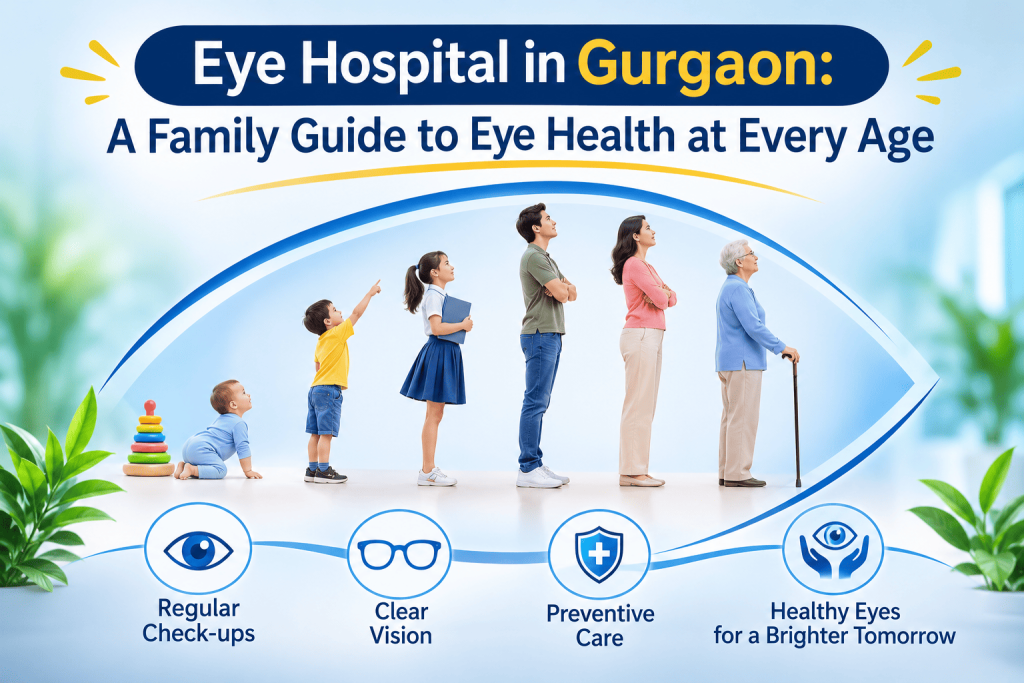
From a child’s first vision concerns to the eye-health priorities of later life, the right care changes with age, health history and everyday needs.
Eyes do not follow a single timetable. A five-year-old who struggles to see the classroom board, a professional who spends hours on digital screens, a person with diabetes and an older adult bothered by night-time glare may all need an eye consultation, but for very different reasons. When families search for an eye hospital in Gurgaon, it helps to think beyond a single symptom or procedure and consider how eye health changes over a lifetime.
This guide explains age-related eye-care priorities, practical prevention, symptoms that deserve attention and how families can prepare for ongoing care. It is not a substitute for an individual eye examination. Ahooja Eye & Dental Institute (AEDI), based in Gurgaon, lists paediatric ophthalmology, cornea, cataract, glaucoma, refractive care, contact lenses and retina services on its official website. The purpose here is to help patients understand when these services may be relevant, not to suggest that everyone needs treatment.
Why age and health history matter more than a one-size-fits-all eye checklist
Good vision is not simply the ability to read the smallest letters on a chart. Eye health includes the development of binocular vision in children, the clarity and stability of the tear film in working adults, the shape of the cornea, the condition of the natural lens, and the health of the retina and optic nerve. Different concerns become more likely at different stages, although an eye disease can occur outside the age group commonly associated with it.
Family history, diabetes, high blood pressure, previous injury, eye surgery, contact-lens use and medications can influence risk and the examination schedule. Someone with no symptoms may still need a dilated eye examination because some conditions develop quietly. Conversely, a new or severe symptom may require immediate attention regardless of age.
The practical goal of family eye care is continuity: recognising changes, keeping useful records, obtaining the right examination at the right time and understanding when prompt assessment matters. A regular plan is especially helpful when different members of a household have different eye-care needs.
Early childhood: protecting vision while the eyes are developing
Children do not always describe poor vision. A child may assume that everyone sees the world as they do, especially when one eye is doing most of the work. Parents may instead notice frequent squinting, closing one eye, a visible eye turn, holding books unusually close, a preference for sitting near the television or difficulty copying from the classroom board. These signs deserve assessment, although none on its own establishes a diagnosis.
One important reason not to delay is amblyopia, often called lazy eye, in which vision development is reduced in one or both eyes. It may be associated with unequal spectacle powers, squint or other conditions that interfere with clear visual input. Early identification can create more opportunity for effective management while the visual system is developing. Treatment depends on the cause and can include appropriate glasses, patching or other clinician-directed measures.
Parents should also take eye alignment concerns seriously. Some apparent eye turns are optical illusions caused by facial features, while others represent real strabismus. An examination is needed to distinguish the two. White appearance of the pupil in photographs, a persistent unusual eye appearance, pain, trauma or a sudden change in vision warrants prompt medical attention.
Children with a known eye condition, a strong family history or concerns raised at school may need a personalised review schedule. For AEDI’s paediatric ophthalmology information, see https://aedi.in/eye-hospital-gurgaon/paediatric-ophthalmology/. The timing of a visit should be guided by the child’s clinical situation, not only a birthday milestone.
School years and teenagers: watching for changing myopia
Myopia, or short-sightedness, often first becomes noticeable when a child struggles to see distant objects such as a school board. A changing glasses prescription can affect sport, classroom participation and confidence. However, headaches or reduced concentration are not proof of myopia: a clinician should determine whether a refractive error or another concern is present.
For children with progressive myopia, the discussion may extend beyond updating spectacles. An eye-care professional may discuss evidence-based myopia-management approaches and whether they are suitable for that child. These require individual assessment, monitoring and consideration of benefits, limitations and risks. A strategy that suits one child may not be appropriate for another.
Encouraging regular outdoor time and sensible breaks from sustained near work can support healthy habits, though these steps do not replace an eye examination or a prescribed management plan. Children should never be blamed for developing myopia. Family history and the biology of eye growth also play a role.
Contact lenses may be considered for some teenagers, but maturity, hand hygiene, care routines and willingness to report discomfort matter. Sleeping in lenses not approved for overnight wear, exposing them to water and ignoring painful redness can increase infection risk. Parents should understand the prescribed wearing schedule and know when to stop lens use and seek care.
Young adults: screen comfort, contact lenses and refractive choices
For many people in their twenties and thirties, the leading concern is visual comfort during work, study or commuting. Long stretches of concentrated screen use can reduce blinking and contribute to dry-eye symptoms, including burning, fluctuating blur and a gritty feeling. These symptoms are common, but persistent redness, pain or reduced vision should not automatically be labelled digital eye strain.
Workplace improvements can include positioning the display comfortably, reducing glare, taking regular changes of focus, blinking fully and discussing dry-eye treatment when symptoms persist. The familiar 20-20-20 practice may help some people take breaks, but it is not a cure for an underlying ocular surface disorder. Eyedrops are not interchangeable; use products recommended for your condition and avoid self-medicating with steroid drops.
Contact lenses can be convenient, yet a good fit, healthy corneal surface and appropriate cleaning are essential. AEDI describes a dedicated contact lens centre at https://aedi.in/eye-hospital-gurgaon/contact-lens-center/. People with recurring irritation or blurred vision while wearing lenses should seek an assessment rather than repeatedly changing brands without advice.
Some adults also ask whether laser vision correction or ICL could reduce dependence on glasses. Eligibility is not based on spectacle power alone. Prescription stability, corneal thickness and shape, dry-eye status, eye disease and individual expectations all matter. The clinician should explain why a procedure is or is not appropriate, reasonable alternatives and possible side effects. A successful reduction in glasses dependence is not the same as guaranteeing perfect vision for life.
The forties and fifties: near vision and changing visual priorities
People commonly notice that small print becomes harder to focus on in their forties. Presbyopia is a normal age-related reduction in the eye’s ability to focus on near objects. It is different from cataract and is not an eye disease. Reading glasses, multifocal spectacles or selected contact-lens options may help, depending on the prescription and daily activities.
This is also a useful life stage for discussing eye-health risks beyond near vision. A parent with glaucoma, a history of steroid use, diabetes or another relevant condition may change the need for monitoring. Glaucoma can damage the optic nerve before a person notices changes in everyday sight. Eye pressure is one part of assessment, not a stand-alone answer.
Patients should also mention increasingly bothersome halos, glare or difficulty driving after dark. These symptoms may be related to prescription changes, dry eye, cataract or other ocular problems. It is better to identify the cause than to assume a particular procedure is needed.
If a person wants less dependence on reading or distance glasses, realistic counselling matters. Options differ in what they can correct, who qualifies and what compromises may occur, including visual quality in low light. A decision should follow a complete evaluation and an honest discussion of needs.
Older adults: cataract, glaucoma and retinal health
With increasing age, cataract becomes a more common explanation for gradually cloudy vision, faded colours and glare from headlights. Cataract surgery may be considered when impaired vision affects important activities and the expected benefit justifies the risks. Not everyone with an early cataract needs surgery immediately. Glasses adjustments, observation and other approaches may be reasonable at first.
When cataract surgery is appropriate, the eye doctor assesses the retina, cornea and optic nerve as well as the lens. Intraocular lens selection should reflect visual goals, measurements and other eye conditions. AEDI provides information about cataract care at https://aedi.in/eye-hospital-gurgaon/cataract-surgery-gurgaon/ and describes laser-assisted options at https://aedi.in/eye-hospital-gurgaon/robotic-bladeless-cataract-surgery/. Laser-assisted technology is not necessary or preferable for every patient, and no technique guarantees freedom from glasses.
Glaucoma is another condition that deserves attention. Many forms cause no early symptoms, and existing optic-nerve damage cannot simply be reversed. Treatment may lower eye pressure and slow further injury, making consistent follow-up important. Patients should continue prescribed medicine unless their treating doctor changes the plan.
Problems affecting the macula and the rest of the retina can interfere with reading, recognising faces or side vision. Age-related macular degeneration, diabetic retinopathy and retinal tears have very different causes and management pathways. An eye examination, sometimes including dilation and appropriate imaging, can help distinguish them. A sudden shower of floaters, flashes or a curtain-like shadow is a reason for urgent assessment, not a routine appointment request.
Diabetes and blood pressure: eye care is part of whole-person care
Diabetes can affect the retinal blood vessels even when sight seems clear. Depending on the findings, the eye doctor may look for diabetic retinopathy or macular oedema and advise follow-up, treatment or coordination with the patient’s diabetes clinician. Good management of blood glucose and other cardiovascular risk factors supports overall health, but does not eliminate the need for an appropriate retinal examination.
High blood pressure can also be associated with changes in the retinal circulation. A person who has both conditions may need a more individualised eye-care schedule than someone without these risks. It is important to tell the ophthalmologist about diagnoses, current medications, recent medical results and any prior retinal treatments.
For background on the types of retinal problems assessed by AEDI, see https://aedi.in/eye-hospital-gurgaon/retina-uvea-services/. The need for imaging or intervention depends on what is found, rather than the presence of diabetes alone. National Eye Institute guidance also emphasises comprehensive dilated eye examinations for early detection of conditions that may not initially cause symptoms.
Corneal health: a concern that can affect several generations
The cornea is the transparent front surface of the eye. Its smooth shape and clarity are central to focused vision. Dry eye, infection, injury, scarring and conditions such as keratoconus can affect it in different ways. Keratoconus often emerges in younger people and changes corneal shape; other corneal problems may arise at any age.
An important warning concerns contact-lens wearers: pain, marked redness, sensitivity to light or a reduction in sight should lead to stopping lens use and prompt assessment because corneal infection is possible. Never try to make painful lens wear tolerable by continuing to wear the lens.
Corneal treatment depends on the specific problem. Some conditions need medication or specialised lenses, while others may require procedures or surgery. AEDI’s official cornea page describes care for keratoconus, corneal ulcers, dry eyes and corneal disorders: https://aedi.in/eye-hospital-gurgaon/cornea-treatment/. Families with a relative affected by a corneal condition should tell the clinician; screening advice can then be individualised.
When is an eye problem urgent?
Not all changes should wait for a scheduled appointment. Seek immediate emergency assessment for sudden loss of vision, a new dark curtain or shadow across sight, sudden flashes with many new floaters, severe eye pain with nausea or blurred vision, major injury and chemical exposure. With a chemical splash, begin flushing the affected eye immediately with clean running water while arranging emergency medical care. Do not delay irrigation to locate a particular hospital.
A painful red eye in someone who wears contact lenses also deserves prompt evaluation. Sudden double vision, particularly with neurological symptoms, may require emergency medical attention. These warning signs are examples, not a complete list. If the problem feels abrupt or severe, seek urgent clinical advice.
For routine concerns such as a gradual change in glasses power, intermittent dryness or planned follow-up, a booked consultation may be suitable. A website listing eye-care services does not establish that emergency care is available 24 hours a day. Confirm service availability directly or use an appropriate emergency facility.
How families can build a practical eye-health routine
An effective routine starts with noticing change. Keep an updated prescription and a record of important diagnoses, operations, allergies, current eye drops and previous test results. Parents can note when a child’s teacher first observed difficulty seeing, and adults can record whether a new symptom is present in one eye or both. This can make a consultation more useful.
Follow-up timing should be based on individual risk rather than a universal rule. A person with established glaucoma, a child with progressive myopia, a patient with diabetes and a healthy adult with no known risk factors do not necessarily need the same interval. Ask your ophthalmologist when the next review is due and which symptoms should bring it forward.
Everyday habits support, but do not replace, medical care. Wear appropriate protective eyewear for hazardous work and sports, use contact lenses as directed, take screen breaks when helpful and avoid sharing prescription medication. If you smoke, stopping supports general health and can reduce risks associated with several eye conditions. Manage chronic medical conditions in coordination with your treating doctors.
For households caring for both children and older relatives, convenience matters too. Keep appointment records in one place, bring a list of medications, and arrange transport after dilating drops if vision may be temporarily affected. Consider having a family member accompany someone who needs help understanding instructions, while respecting the patient’s preferences and privacy.
Eye care services at Ahooja Eye & Dental Institute, Gurgaon
Ahooja Eye & Dental Institute identifies itself as an eye and dental hospital located in Gurgaon, Haryana. The hospital website states that it was established in 1969 and describes services spanning cataract, cornea, glaucoma, contact lenses, paediatric ophthalmology, refractive care and retina. These different clinical areas may be relevant to families looking for ongoing eye care across age groups.
Choosing an eye hospital in Gurgaon should involve more than a broad list of specialties. Ask whether the relevant clinician and service are available for your concern, whether your visit is routine or urgent, what records to bring and how follow-up is coordinated. If you are considering a procedure, ask for an individual explanation of benefits, alternatives, limitations, costs and risks.
For the hospital’s general service information, visit https://aedi.in/. To request an appointment, use the official booking page https://aedi.in/contact-us/book-appointment/. Availability, consultation hours and preparation instructions should be confirmed with AEDI before visiting.
Frequently asked questions about family eye care in Gurgaon
1. Can children have an eye problem even if they do not complain?
Yes. Some children adapt to reduced vision, particularly when one eye sees better than the other. A visible eye turn, unusual visual behaviour or school-related difficulties should prompt assessment.
2. Does a teenager need a new spectacle prescription every year?
Not automatically. The timing of prescription reviews depends on symptoms, visual needs and whether myopia is changing. The eye-care professional can recommend a schedule.
3. Are screen breaks enough to treat dry eyes?
Breaks may improve comfort, but persistent symptoms can have several causes. Tear-film assessment and suitable treatment may be necessary, especially if redness or fluctuating vision continues.
4. Can an adult with stable glasses power still develop an eye disease?
Yes. Conditions affecting the optic nerve or retina can develop without a noticeable change in spectacle power. Risk factors and examination findings guide screening.
5. Is near-vision difficulty after forty always cataract?
No. Presbyopia commonly affects near focus during midlife. Cataract and other eye conditions can also change vision, so an examination helps clarify the cause.
6. Does every older person with cataract need immediate surgery?
No. The decision depends on symptoms, how vision affects daily life, overall eye health and expected benefit. Monitoring may be appropriate for some people.
7. Can diabetes damage the eyes before vision becomes blurry?
Yes. Diabetic retinal changes may initially be symptom-free. Ask your healthcare professional how often you need a dilated retinal examination.
8. Should a contact-lens wearer ignore occasional painful redness?
No. Stop using the lenses and seek prompt advice, especially if there is pain, light sensitivity or reduced sight. Corneal infection can be serious.
9. Can glaucoma be ruled out by normal eye pressure alone?
No. Glaucoma assessment considers the optic nerve and other findings. Some people have glaucoma despite pressure measurements within a typical range.
10. How can a family book eye care at AEDI in Gurgaon?
The official eye-care telephone number is 8130784234 and the board number is 0124-2321234. You can also use https://aedi.in/contact-us/book-appointment/. Confirm the relevant specialist and appointment timing.
Book an eye consultation in Gurgaon
Ahooja Eye & Dental Institute (AEDI), 560/1, Dayanand Colony, New Railway Road, Gurgaon, Haryana, India.
Eye-care enquiries: 8130784234. Board: 0124-2321234. Official website: https://aedi.in/. Appointment information: https://aedi.in/contact-us/book-appointment/. Contact the hospital to confirm the clinician, appointment availability and any requirements before attending. For emergencies, seek immediate appropriate medical attention.
Conclusion: make eye care fit the person, not just the age
A family’s eye-health needs change over time. Children need attention to visual development, teenagers may need myopia monitoring, working adults may face ocular surface and contact-lens concerns, and older adults may need closer evaluation of the lens, optic nerve and retina. Health conditions such as diabetes can influence care at any age.
The value of an eye hospital in Gurgaon lies in obtaining a careful diagnosis, understandable advice and a follow-up plan appropriate for the individual. Knowing what to watch for, keeping records and seeking timely evaluation can help families make informed decisions about their sight.
